What we clear around Washington
Most land clearing calls we get in and around Washington Borough and Washington Township fall into a few groups:
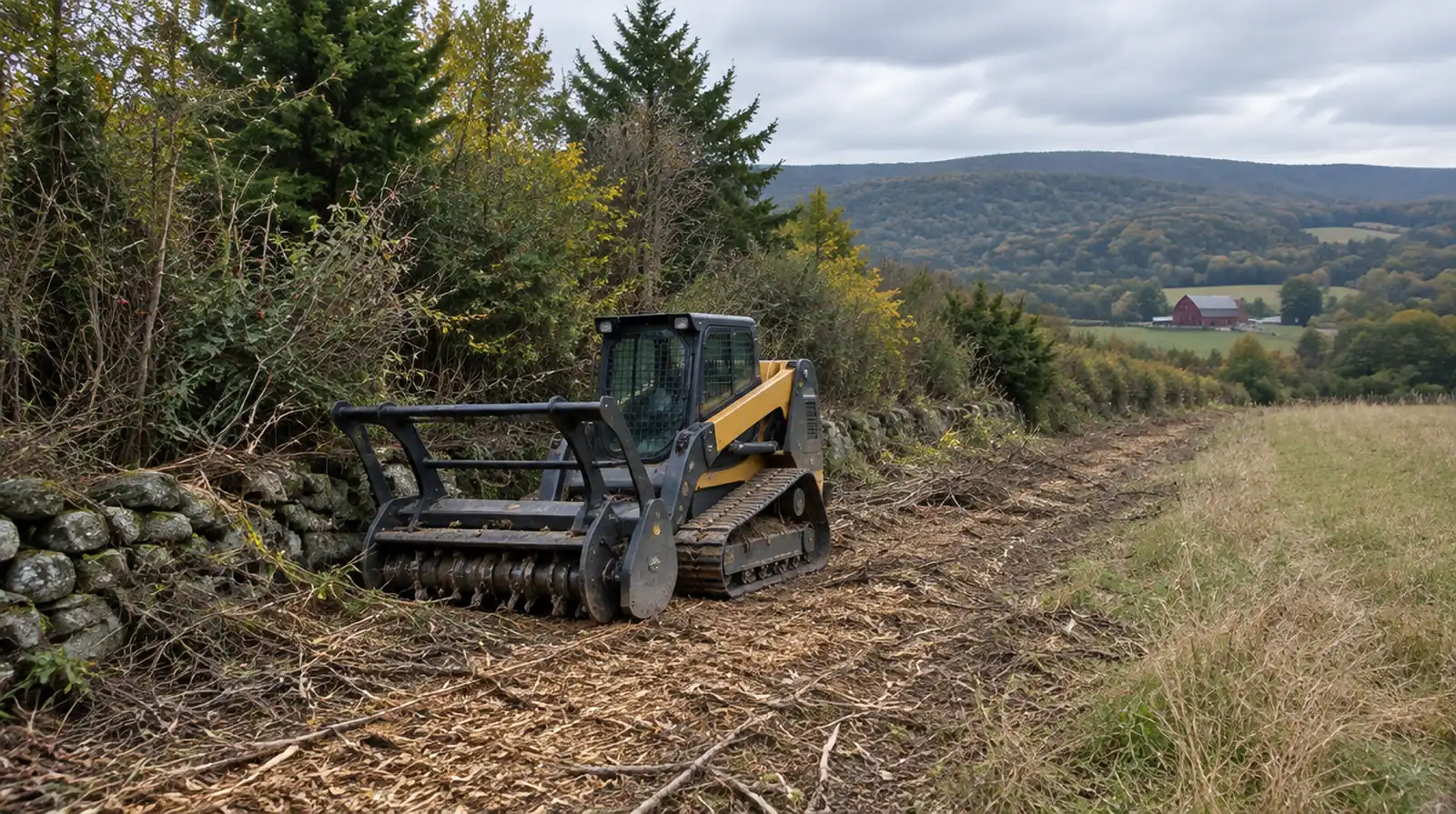
- Old fields gone wild. Pasture and hay ground that has not been mowed in ten or twenty years turns into a thicket of eastern red cedar, black locust, sumac, autumn olive and multiflora rose. We take it back to open ground you can mow again.
- Hedgerows and fence lines. Many properties still have the old stone-wall fence lines from the farm days, now buried in vines and trees. We open them up, save the good trees and leave the stone walls intact.
- House and addition sites. Clearing the footprint for a new home, garage, pole barn or septic field, plus a path for the driveway and the utility trench.
- Dead ash. Emerald ash borer has killed most of the ash in Warren County. Standing dead ash turns brittle quickly and is risky to fell by hand, so we often remove it as part of a larger clearing job.
- Views and sunlight. Thinning the slope behind a house to open up a view of the valley or to get sun on a garden or solar panels.
The ground here shapes the job
Washington sits in the Pohatcong Valley with Scotts Mountain to the north and Pohatcong Mountain to the south, and the ground changes fast over short distances. The valley floor is limestone country. Limestone can dissolve underground, and parts of Warren County are known for sinkholes, so we keep heavy equipment off any soft spots, depressions or open holes we find, and we will point them out to you before anyone builds near them.
Up on the ridges the soil is thin and rocky over hard Highlands bedrock. Stumps there often wrap around boulders, and pulling them can rip up more ground than you want. On those sites we usually grind stumps below grade instead of pulling them, unless the spot is going under a foundation.
Wet spots matter too. Small streams feeding the Pohatcong Creek and the Musconetcong River run through many back lots. We keep clearing away from stream banks and wet ground unless you already have the approvals to work there.
Permits and rules to know before we start
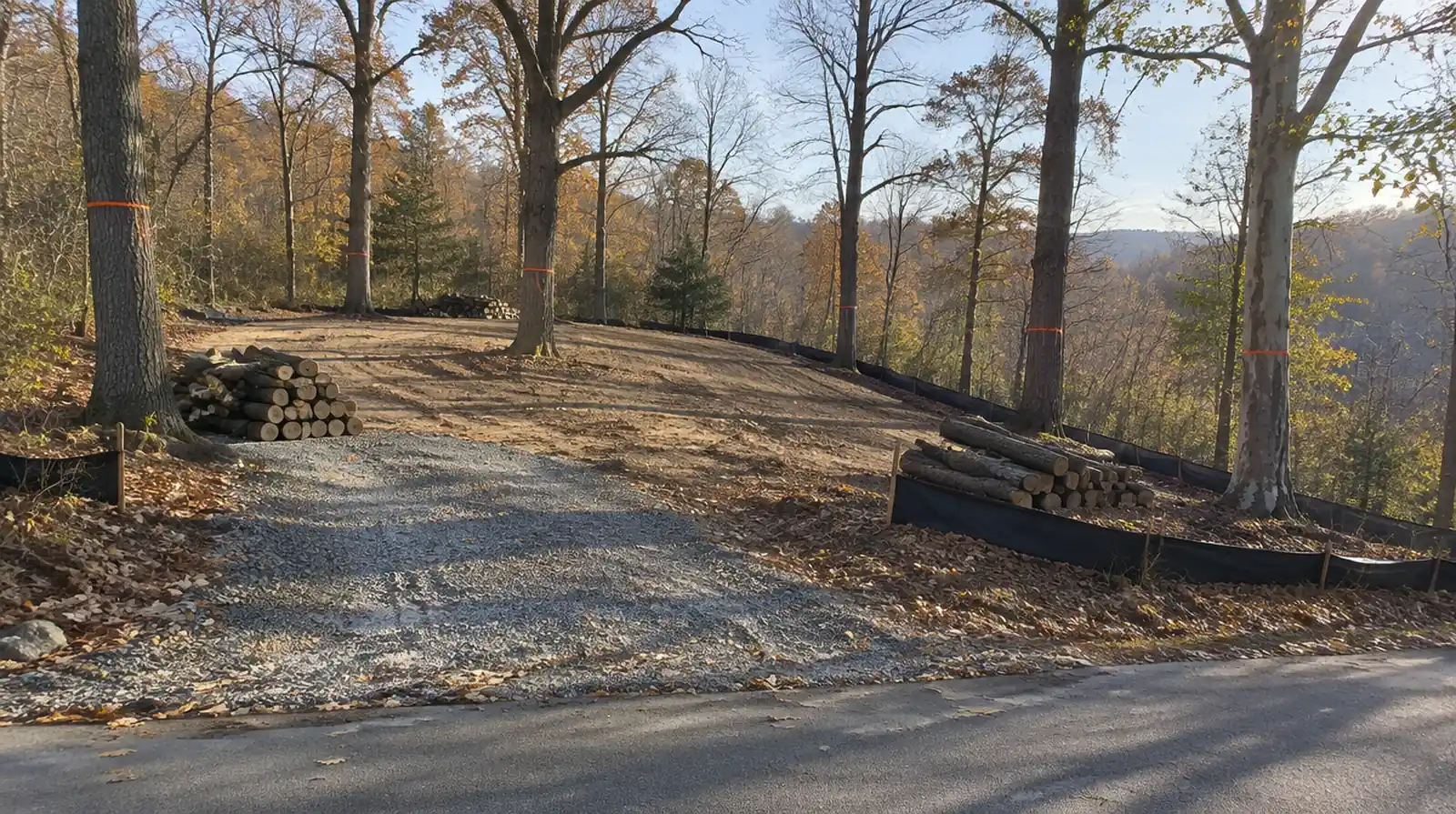
New Jersey requires a certified soil erosion and sediment control plan from the local soil conservation district when a project disturbs more than 5,000 square feet of ground. Many house sites and driveway projects cross that line. If your job needs a plan, we will tell you up front and work to the plan once it is approved, including the silt fence and stone construction entrance it calls for.
Washington is also inside the New Jersey Highlands region, and some towns in the area have their own tree removal or steep slope rules. Requirements differ between the borough and the township, so check with your municipal office, or let us know which one you are in and we can tell you what we usually see. If you plan to build, your builder or engineer should have the site plan before we clear a single tree.
How a clearing job goes
- Walk and flag. We walk the property with you and flag the trees you want to keep. Big healthy oaks, sugar maples, tulip poplars and black walnuts are often worth saving, and we keep machines outside their drip line where we can.
- Cut and sort. Larger trees are felled and bucked into firewood lengths, which we can stack for you or haul away. Smaller brush goes through the chipper or the forestry mulcher.
- Mulch or haul. Mulching in place is often the cheapest option and leaves a layer that protects bare soil from washing out on a slope. Where you need clean ground for building, we haul the debris instead.
- Stumps. Ground below grade, or pulled where the ground will be excavated anyway.
- Leave it stable. We do not leave bare, rutted slopes behind. Mulch, straw or seed goes down where the ground could wash.
Invasives come back if you let them
Autumn olive, multiflora rose, Japanese barberry and tree-of-heaven all resprout from roots after cutting. Tree-of-heaven is also the favorite host of the spotted lanternfly, which has spread across Warren County. Clearing alone will not keep them away. We will explain what to expect after the job, whether that is a season of regular mowing on reclaimed pasture or follow-up treatment of the resprouts.
When to clear
Late fall and winter are usually the best time in Washington. Leaves are down, so it is easy to see what you are keeping. Ground that freezes hard in January carries machines with less rutting. Most birds are done nesting, too. Spring mud season, roughly March into April, is the hardest time for heavy equipment on wet valley soils, so we plan around it when we can.
Common questions
Can you clear just part of my lot? Yes. Plenty of jobs are only the brush under the trees, or a single strip for a driveway or fence.
Do you take the wood? We can haul it, leave it cut for firewood or chip it on site. Many clients keep the oak and haul the rest.
Do you work outside the borough? Yes, including Washington Township, Oxford, Franklin Township, Mansfield, Port Murray and the rest of the valley.
Walk the lot with us
Call (908) 402-4345 and we will walk the property with you, flag what stays and give you a price to clear the rest.